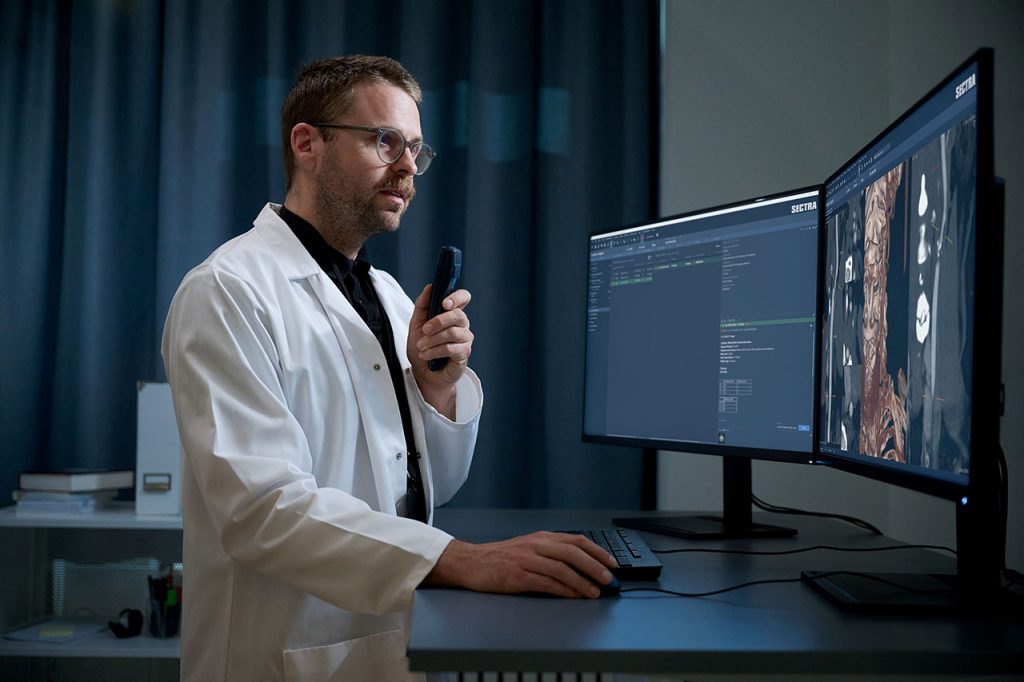
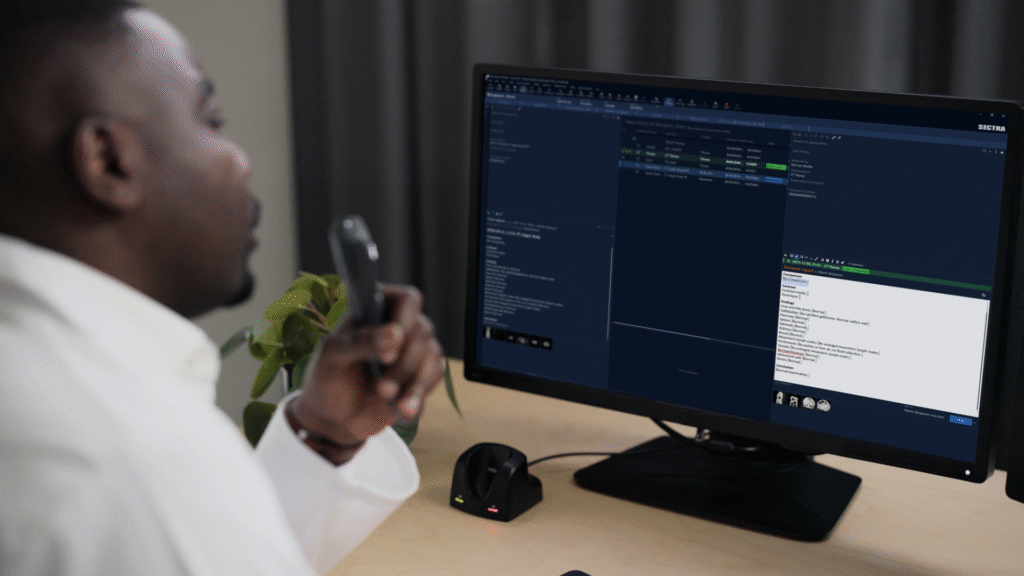
As PowerScribe 360 sunsets, you as a Sectra customer have a clear path forward. Stay in a single, integrated system. No new vendor. No new contract. No workflow disruption.
Your reporting strategy is yours to shape. We’re here to give you a path forward and stay with you while you do.
Reporting built natively into your diagnostic application means you stay in one system. Images, AI, and reports live together, removing the friction that slows your workflow today.
When PowerScribe 360 reaches end-of-life, Sectra’s native reporting means fewer integrations, fewer support tickets, and one renewal conversation. Fewer moving parts means less risk.
Built and refined with radiologists like you. You get a partner who stays through the transition, not one who disappears after signing.
Integration No context switching. No extra logins.
Simplicity One less vendor. One less contract.
Partnership Built with you. Backed by us.
Webinar: "Reporting doesn’t have to be another system: a more integrated approach"
Our clinical and product teams joined SIIM to walk through the reporting roadmap, integration architecture, and what the transition path looks like for current Sectra customers. See our reporting solution in action at SIIM 2026.
13 years Best in KLAS in a row
2,500+ Sectra installations globally
Q1 2027 Projected US availability
It’s an add-on
When you’re done juggling multiple applications, the Sectra Reporting add-on is here for you. It integrates seamlessly with Sectra IDS7, so that you can complete your report side-by-side with your medical images. Made to make your work a little bit less complicated.
The radiologist stays on the image. Worklist, priors, measurements, and AI results share one reading environment with the report, so values flow straight in. No copy-paste between systems, and no double dictation, reading a value aloud just to carry it across. Less mouse mileage, and less eye mileage. Reporting and the PACS are built with each other in mind, so they stay in step and the data you already hold is right there in the report. For your IT team, that’s one less vendor.
Reporting is built on the Sectra Workflow Orchestration platform, the same engine behind your worklists and workload balancing. Multi-specialty reading, tumor boards, peer review, and chat all live in that environment too, so a radiologist moves from worklist to images to report to signing without changing tools.
It’s a long-term commitment, and it began well before PowerScribe 360’s end of life was announced. We’ve built PACS-native reporting in other markets for more than a decade, across 150 sites and around 30 million signed reports a year. We moved into the US because the reporting market here is fragmenting and demand for integrated solutions is growing. Sectra Reporting itself is new, and it’s built on that track record. It’s one of our largest development investments, approved at board level. And because Sectra is publicly listed and founder-controlled, we invest on a horizon of years rather than the next funding round.
Yes. It looks at how you’ve written impressions for that type of study before and adapts the draft to match your own style, using a vector-based search across your prior reports. There’s no per-user training, so it works from your first case. A safety check compares each draft against your findings before it reaches you, and we track how much of each draft radiologists keep versus change, so we can see in real use whether it’s helping. You accept the draft or edit it, and you sign.
AI-assisted quality assurance is built in. Before you sign, it looks for laterality errors, internal contradictions, and omissions, and flags anything that conflicts with your findings. It stays quiet on a clean report. You always make the final call and sign.
It summarizes the patient’s prior reports and imaging history, so you have the context without reading back through every prior study. Your priors already live in the system, so nothing has to be fetched from outside. We’re maturing it through go-live, and extending it toward outside documents and Epic chart context.
You dictate the report the way you’d talk through a case, without stopping to fill in template fields, and the content lands in the right place as you speak. We’re improving it as we go. Further out, we’re heading toward conversational reporting, where the report arrives already drafted from data pulled together across systems, and you enrich and refine it in free-form as you talk. You stay the one who reviews and signs.
Sectra’s reporting AI does not train on your patient data. The impression feature reads each radiologist’s own prior reports at the moment of dictation, and nothing you write feeds back into a shared model. Everything runs in Microsoft Azure with SSO, encryption, and full audit logging, managed by Sectra’s own cloud-security organization. Speech recognition uses Nuance’s medical engine, and we’ll walk your team through exactly how data is handled at every step.
Sectra Amplifier, our in-PACS marketplace for AI, runs algorithms from a broad range of vendors and maps their results straight into report fields. With Amplifier we also keep watching how each algorithm performs once it’s live, so a drop in accuracy gets caught instead of sitting unnoticed. You’re not tied to Amplifier, either. We can take in DICOM SR results from external or customer-built systems the same way, and they land in the report rather than in a system you run on the side.
Yes. Sectra Reporting comes as part of the Sectra platform rather than on its own, and that’s deliberate. It’s how we make sure reporting and the PACS keep moving forward together, with image tools, worklists, and reporting evolving in step instead of drifting apart across a vendor boundary. It also fits our wider diagnostic strategy, where reporting builds on everything else you already run with us.
Less than you’d expect. You’re extending a vendor you already run rather than onboarding a new one, so much of the security review and architecture fit is already behind you. Reporting reuses the users, roles, and worklists you’ve configured in PACS, with no second login or separate permission model to keep in sync, and your current PACS administrators can run it. On security, Sectra’s parent company builds cryptographic and secure-communications systems for European governments and NATO, and that expertise carries into our imaging products.
We take that on. Your existing templates are converted into the Sectra format with AI-assisted migration, and customers have already worked on their converted templates during evaluations. We scope your library together up front, so your readers aren’t starting from a blank page.
No. Your prior reports already live in the PACS, so there’s no separate migration to run or validate. They’re available the moment you start reading
Reports flow to Epic over standard HL7, the way they do today, and discrete values can cross as structured data rather than plain text. Patient context stays in sync both ways, so orders, referrals, and clinical detail surface in the reading workflow. We’re taking that further, including work with Epic over FHIRcast.
Speech recognition uses Dragon Medical SpeechKit, Nuance’s flagship medical engine, with no per-user training. The Nuance PowerMic 4 and Philips SpeechMike work out of the box with native button mappings. Other high-end microphones are supported as well, using keyboard and mouse shortcuts where they lack dedicated buttons. Voice commands are built into the workflow.
An attending reviews and attests before a report is finalized, with change tracking and notifications flowing between resident and attending. Case types are tracked for case-mix and graduation requirements, all inside one supervision flow.
Peer review and teaching files are built in, with anonymization and configurable grading that cover ACR RADPEER and internal peer learning. They run inside the same reading session your radiologists already work in.
Updates arrive continuously on Azure, with no annual upgrade windows and no downtime. Routine patches run in the background. New functionality rolls out in stages, enabled for a smaller group of readers before it reaches everyone, and we give you notice before anything changes how your radiologists work. Sectra Monitoring, already on your PACS, covers reporting under the same agreement.
What we ship is driven by customer input: time on site with readers, support cases, our NPS program, KLAS, and our radiology advisory boards. With close partners we review the backlog together and agree what comes next. It’s built by focused teams in a single product organization, and the people who build it stay with it from one release to the next, many of them twenty years into radiology software. Every change is assessed for clinical risk before any code is written, and we never trade patient safety or security against the schedule.
Sectra Reporting is delivered as a cloud service on Azure, spread across availability zones for redundancy, and the team that builds it also operates it. Service availability, response times, and error rates are watched continuously and reviewed every day, so many issues are caught before they reach the reading room. Sectra Monitoring covers reporting under your existing support contract, with 24/7 detection and response and regular disaster-recovery testing. Before go-live we work through the fallback workflows with your team, so everyone knows how reading continues if a component goes down.